
Empower your investment journey with knowledge. Subscribe to NAOS News & Insights.
By subscribing you consent to NAOS using your personal information in accordance with its Privacy Policy, a copy of which is available here.
By subscribing you consent to NAOS using your personal information in accordance with its Privacy Policy, a copy of which is available here.



Australia's 2027 capital gains tax changes explained for LIC shareholders: what's actually changing, why franking is untouched, and what to do before June 2027.
From 1 July 2027, Australia changes the way it taxes capital gains. The headlines have been loud, the commentary has been mixed, and very little of it was written with Listed Investment Company (LIC) shareholders in mind. That leaves a practical problem: it’s hard to tell which parts of the noise actually apply to you.
We've put this paper together to separate the noise from the facts. It covers the following key topics:
Under the current rules, if you hold an eligible asset for at least 12 months you can generally halve the capital gain before tax applies. That's the 50% discount. It's been part of the system since 1999.
In numbers, using the same $100,000 purchase and $150,000 sale as the examples later in this paper:

From 1 July 2027, the discount goes, but only for growth from that date onwards. Growth built up before then keeps the discount when you eventually sell.
Two things take its place.
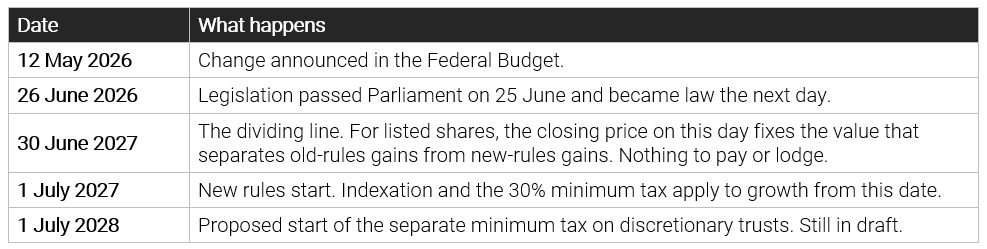
These new rules passed the Parliament on 25 June 2026 and became law the next day, so this is no longer a proposal. Further technical legislation is still working its way through to deal with more complex situations, and a separate minimum tax on discretionary trusts, which starts a year later on 1 July 2028, is still in draft form. Both are beyond this paper. The core rules for shares are settled.
One more thing worth knowing about the scope. Housing has its own carve-outs, including a choice of methods for investors in new residential builds, and the existing small business CGT concessions stay in place. Those areas are beyond this paper, which sticks to what matters for shares.
It's easier to follow with numbers. These ones are invented, but the method is exactly what the law does.
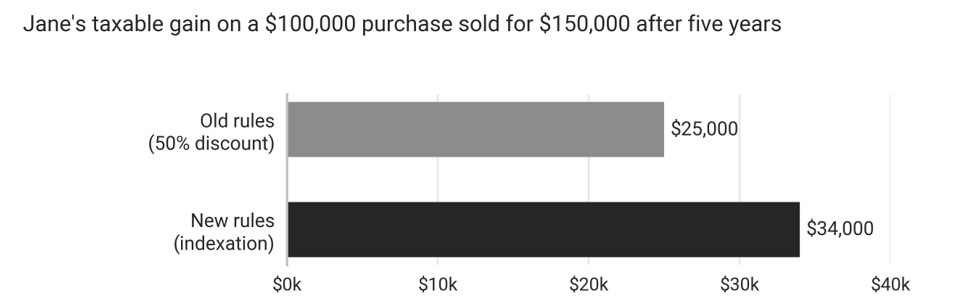
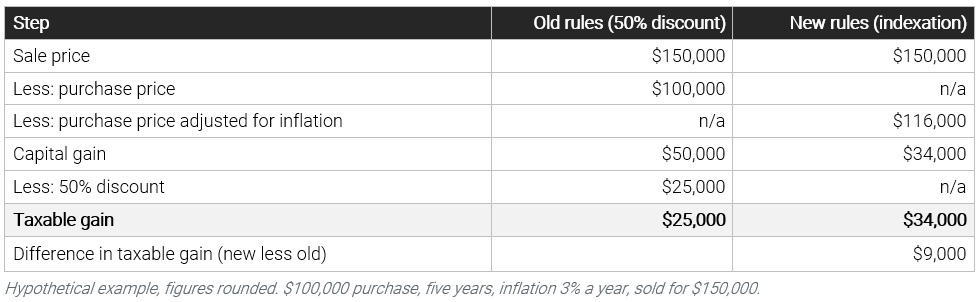
Say Jane Mitchell buys a parcel of shares for $100,000 in late 2027, after the new rules have started, and holds them for five years, with inflation running at about 3% a year.
In this example, the new rules produce the larger taxable gain, $34,000 against $25,000.
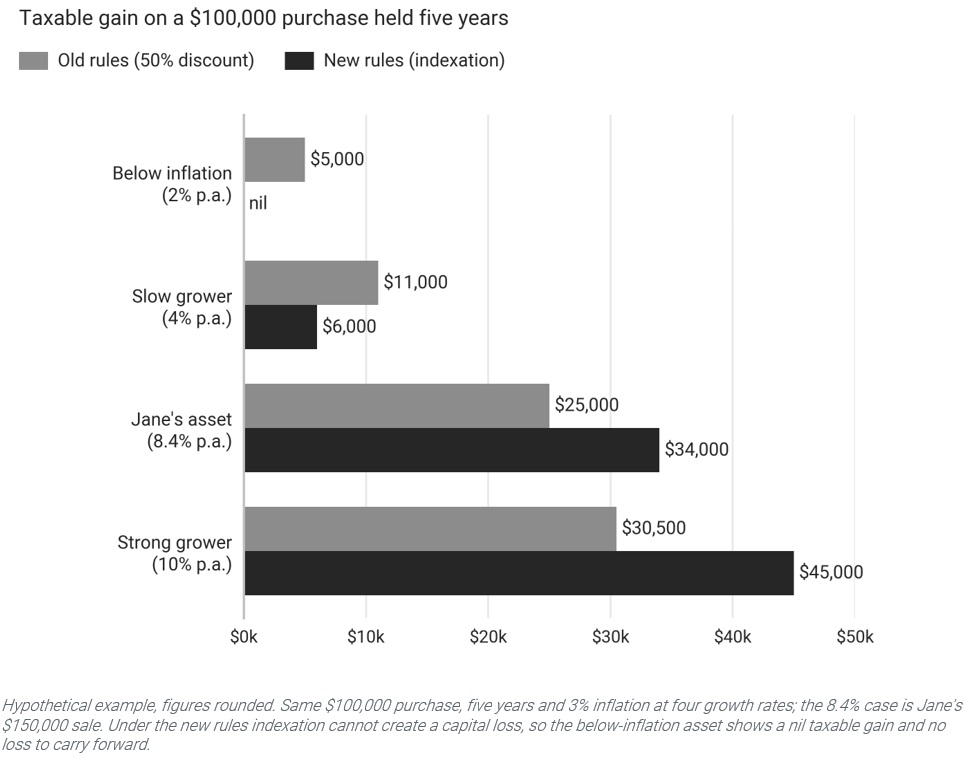
Run the same numbers with an asset that only just outpaces inflation, though, and indexation can produce a smaller taxable gain than the discount would have. Which way it falls for any investor depends on three factors:
As a rule of thumb, investments that grow only a little faster than inflation come out better under indexation, while strong performers face more tax than the old 50% discount would have produced. Higher inflation makes indexation more generous, lower inflation less so. The chart below runs the same $100,000 example at four growth rates, including Jane's.
What's true for everyone is the extra paperwork: the calculation for a net capital gain grows from five steps to seven, and gains now have to be sorted by when they accrued and what type of asset produced them.
Two parts of the new rules get less attention than the headline change. Both matter if you own shares.
The first is that indexation only works one way. It can reduce a capital gain, but it cannot create or increase a capital loss. If an asset grows by less than inflation you have gone backwards in real terms, but there is no capital loss to set against other gains. The below-inflation bar in the chart above shows this: a nil taxable gain, and nothing to carry forward. The same rule applied under the 1985 to 1999 indexation system and it is written into the new law.
The second is that the change lands hardest on the investments that do best. The old discount halved the gain whatever its size, so the bigger the gain, the bigger the relief. Indexation only strips out inflation. The further an asset grows above inflation, the more of the gain is taxed in full, and there is no offsetting relief for an asset that only keeps pace with prices. The Treasurer acknowledged this in Parliament: some investors will pay more under the new rules and some will pay less, depending on how their returns compare with inflation.
It is relevant to NAOS shareholders because the businesses we own are selected for their capacity to grow well ahead of inflation over many years. The reform does not touch the LIC itself, which is taxed on the full capital gain now and will be after 1 July 2027, and it has no effect on how the portfolio is managed. It does apply to your LIC shares in the same way as to any other share you hold directly: the more successful the holding after 1 July 2027, the larger the proportion of the gain taxed in full when you sell. That is a reason to understand the arithmetic and keep good records. It is not, in our view, a reason to hold different businesses.
Australia has redesigned its capital gains tax roughly once a generation.
Before 20 September 1985 there was no general capital gains tax at all. Most gains were simply tax-free. The Hawke government introduced CGT from that date, and the original design should sound familiar: cost bases were indexed for inflation, so only real gains were taxed, and an averaging mechanism smoothed the effect of a large gain landing in a single year.
This lasted 14 years. In 1999, following the Ralph review of business taxation, the Howard government swapped indexation and averaging for something simpler: the 50% discount for individuals and trusts, with a one-third discount for super funds.
Companies were left out and taxed on full capital gains, which is why a LIC has never had the discount. The 1999 Howard Government change was pitched as simplification, and it was. It also meant that in high inflation years investors were taxed on gains that were partly just inflation.
That brings us to now. The May 2026 Budget proposed replacing the discount altogether, and the change moved quickly: the bill went to Parliament on 28 May 2026, passed with amendments on 25 June, and became law on 26 June. The new rules take effect from 1 July 2027.
So, in 40 years the system has gone from no tax, to indexation, to a discount methodology, and now back to indexation with a floor.
Remember Jane Mitchell from our earlier example? Years ago, she bought $10,000 of listed investment company (LIC) shares in her name. Just before 1 July 2027, they’re worth $18,000. A few years later she sells the lot for $30,000.
Her $20,000 gain gets split in two.
a) The first $8,000 grew before the 1 July 2027 changeover, so it's set aside and taxed under the old rules when she sells, provided the usual conditions are met.
b) The remaining $12,000 grew after the changeover, so it's taxed under the new rules: her cost base is indexed for inflation from that point, and the 30% minimum tax may apply to the real gain.

If she holds for another three years with inflation at 3%, the new-rules part is roughly $10,300 after indexation and the old-rules part $4,000 after the discount: a total taxable gain of about $14,300 on a $20,000 gain, before the 30% floor is considered on the new part.
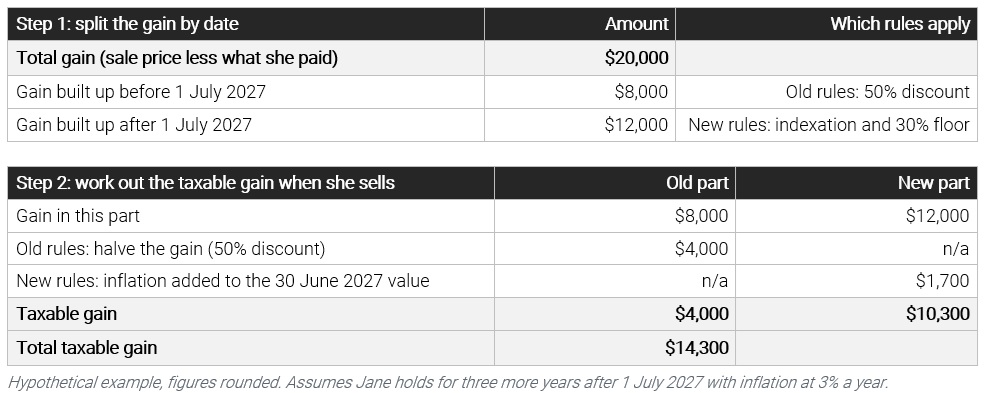
An important part people miss is that on 1 July 2027 itself, Jane paid nothing, lodged nothing and made no decisions. The date split her unrealised capital gain; it did not tax it. The tax occurs when the capital gain is realised.
Real portfolios are, of course, messier. Multiple parcels bought at different times, dividend reinvestment plan (DRP) shares, capital losses and the structure you hold shares in all change the arithmetic. Regardless, the principle holds: old gains, old treatment; new gains, new treatment; and nothing to pay on day one.
It helps to picture two separate layers of tax, because the reform treats them very differently.
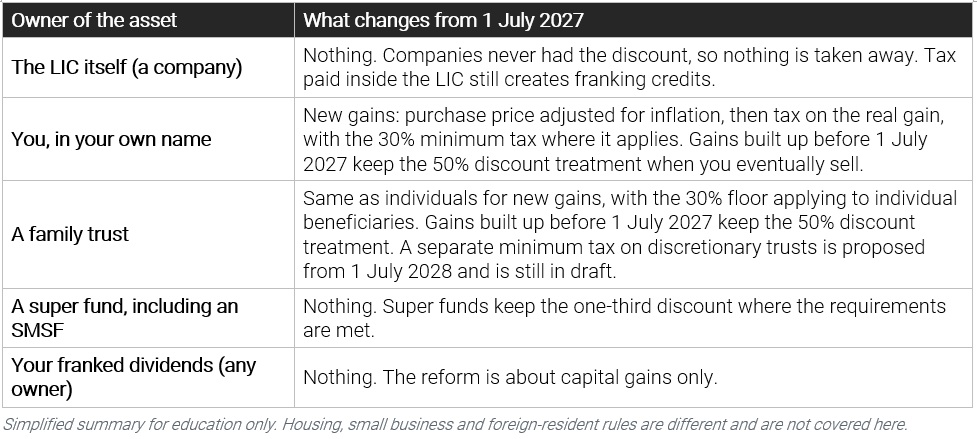
The reform is about capital gains. Franking sits outside it.
A franked dividend still arrives with a franking credit for the company tax already paid on that profit. You include both the dividend and the franking credit in your return, the credit counts toward your own tax, and refunds of excess credits remain available to eligible taxpayers under current law. None of that machinery is touched by the 1 July 2027 changes.
A few misunderstandings keep coming up in questions from shareholders, so it is worth clarifying them directly.
There are no forms to lodge, no elections to make and no payment due on the 1 July 2027 changeover date. The one thing that genuinely matters is record-keeping.
Purchase contracts, brokerage statements, DRP allotment notices and paperwork from rights issues, share purchase plans (SPPs) and other capital raisings all help establish what belongs to the old rules and what belongs to the new ones. For listed shares, the closing price on 30 June 2027 sets the dividing line between old-rules and new-rules gains, and your broker or the share registry will have it. Two other timing points are worth knowing: a sale counts on the trade date, not the settlement date, and each dividend reinvestment allotment is its own parcel with its own purchase date, so DRP shares allotted after 1 July 2027 sit entirely under the new rules.
One caution. The changeover is a tax event, not an investment signal. Selling something you’d otherwise keep, purely to manage a tax outcome, is a decision to take advice on, not one to make off the back of general commentary.
The 1 July 2027 reform is a big change to how capital gains are taxed. It is not a change to the investment itself.
Tax is one input into an investment decision, and rarely the only one. Portfolio quality, performance, the share price relative to net tangible assets (NTA), fees, dividend sustainability and your own horizon matter more.
This paper is general information only. If your affairs are complex, particularly if you hold through a discretionary trust, talk to your tax adviser well before June 2027.
Further reading: the ATO's summary of the new law (ato.gov.au, "Tax reform: reforming negative gearing and capital gains tax") and Treasury's Budget 2026-27 tax explainer on negative gearing and capital gains tax reform (budget.gov.au).
Join our investment community. Be the first to receive NAOS News, Podcasts, Insights and Invitations.
By subscribing, you consent to NAOS using your personal information in accordance with its Privacy Policy, a copy of which is available here.


Join our investment community. Be the first to receive NAOS News, Insights and Invitations.


